
Winter Guide
Can You Coat a Garage Floor in a Colorado Winter? Slab Temperature, Road Salt, and Scheduling
Why slab temperature, road salt and the forecast for the whole cure decide whether a winter garage floor install is a go.
Published
The air temperature doesn't decide whether your floor cures. The slab does. A warm, sunny afternoon can sit on top of a garage slab that is still holding last night's cold, and the coating only knows what the concrete underneath it is doing.
The short answer: yes, a garage floor can sometimes be coated in a Colorado winter, but only when the slab itself is warm enough for the specific product, stays warm enough for the whole cure, and is clean of the road salt that's been tracked in since the first storm. If any of those three fail, the right call is to wait.
Winter showed up on October 16
Denver officially recorded its first freeze of the season on Friday, October 16, 2026, at 28°F at Denver International Airport, according to 9NEWS. The average first freeze is October 7, and the same report forecast temperatures back in the 70s that weekend. That's the Front Range in a sentence: big swings between night and day. Those swings are why a warm afternoon can't tell you much about a slab.
Why slab temperature matters more than air temperature
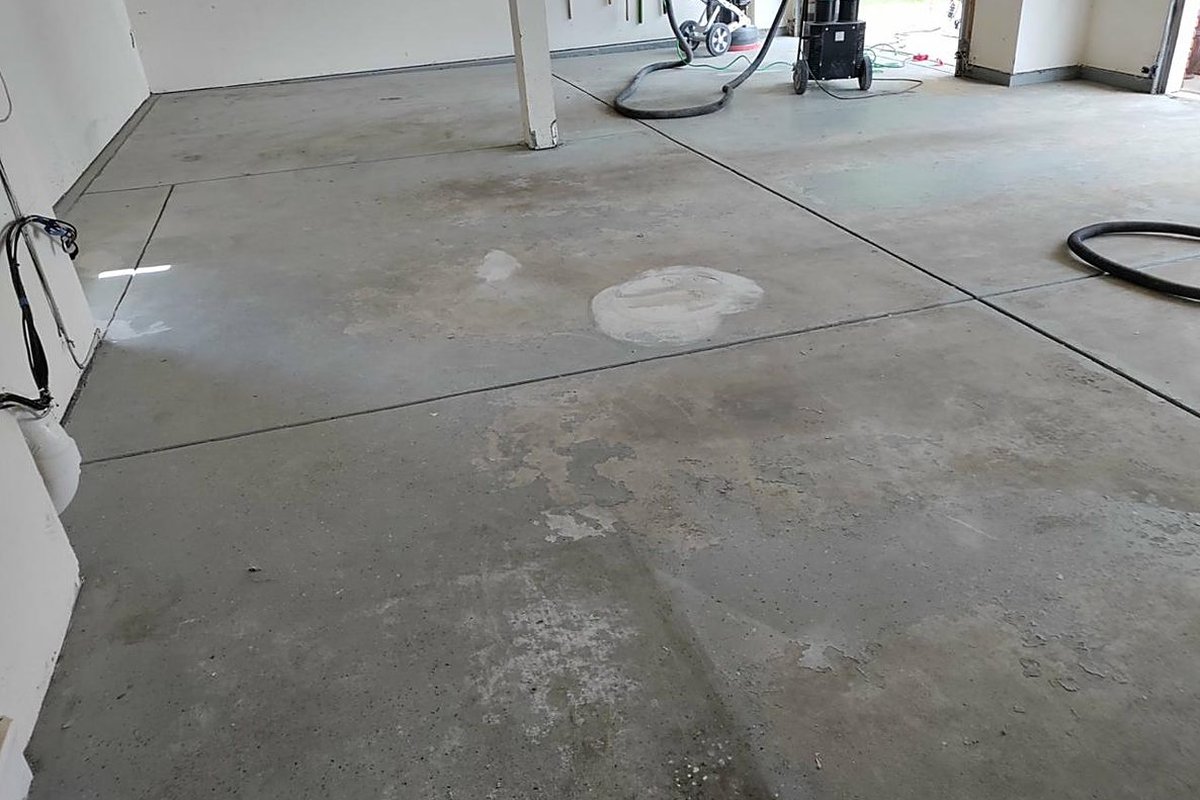
Epoxy cures through a chemical reaction between resin and hardener. Euclid Chemical explains that both the air temperature and the concrete temperature affect how fast that reaction runs and how completely it cures. A coating applied too cold "may appear sufficiently hardened, but it will not reach a complete cure or achieve its designed physical properties," which leads to premature failure.
Euclid's general guidance:
- Most epoxies, unless specifically formulated for cold weather, will never fully cure below 50°F.
- As a rule of thumb, cure time doubles for every 18°F drop below 70°F.
- Cold epoxy gets thick, which makes it harder to mix thoroughly and can cause an uneven look and air bubbles.
- The area has to stay heated for the full cure time, not just during application.
Product labels make this concrete. The Rust-Oleum EPOXYSHIELD instructions, for example, list a minimum floor temperature of 55°F, ideal air temperatures of 60–85°F with humidity below 80%, and say not to apply the coating if temperatures are expected to drop below 65°F in the 24–48 hours after application. Every product sets its own limits, so the data sheet for the exact product on your floor is what counts.
Low-temperature coatings exist, with trade-offs
Some epoxies are built for the cold. The APF L.T.E. Low Temperature Epoxy data sheet describes a product designed to cure down to 35°F for cold-weather and refrigerated areas. The same sheet lists limitations: don't apply below 35°F, because application below freezing may not bond due to ice crystals in the concrete; a test patch should always be done to check adhesion; it yellows under UV and isn't meant as a decorative topcoat; and kerosene or propane forced-air heaters used during application may cause discoloration and finish defects.
So "winter-rated" is a property of a specific product, not of epoxy in general, and even cold-cure products have a floor. Topcoats behave the same way: cooler slabs slow a polyaspartic cure too. See polyaspartic cure time in Colorado and epoxy vs polyaspartic in Colorado for how the two layers work together.
The road salt problem nobody sees
By the time most people think about a winter install, the garage slab has already taken a few weeks of snowmelt and deicer dripping off the car. That brine doesn't just sit on top. The FHWA notes that where salty water pools on concrete (in its research, at pavement joints), it's absorbed into the exposed concrete and grows more concentrated as more deicing salt is used. That research is about roads, but a garage slab under a car dripping brine all winter is a similar situation.
Anything sitting between a coating and the concrete works against the bond, so a slab that has spent weeks under a salty car needs a careful look before it is coated.
If winter has already done damage, such as flaking, pitting or spalled spots on the interior slab, that needs concrete repair before any coating goes down.
A go/no-go check for a winter garage floor
Before anyone opens a kit, every one of these should be a yes:
- The slab, not the air, meets the product's minimum. Measure the concrete surface and compare it to the floor temperature on that product's data sheet (55°F for EPOXYSHIELD, per Rust-Oleum).
- It will stay there for the whole cure. Check the forecast for the full cure window, not just install day. Euclid says the area must stay heated for the full cure, and Rust-Oleum's sheet looks 24–48 hours ahead.
- The product is made for these conditions. If the slab can't stay above 50°F and the product isn't formulated for cold, Euclid's guidance says it won't fully cure.
- Any heat is safe for the coating. Euclid warns against unvented open-flame heaters because exhaust can contaminate the surface and affect the cure, and APF warns that kerosene or propane forced-air heat can discolor the finish.
- The slab is clean and sound. Salt, moisture and damaged concrete are handled first.
If your slab can't meet those conditions, waiting for a warmer stretch beats a coating that never fully cures. Front Range weather swings fast, as the 70s that followed this year's first freeze show. Read more about the best garage floor coating for Colorado winters and flake epoxy garage floors.
Thinking about a new garage floor this winter or next spring? Request a free estimate and we'll take a look at your slab.
Sources
- 9NEWS: Denver, much of Front Range records first freeze of the season (Oct 16, 2026)
- Rust-Oleum EPOXYSHIELD garage floor coating instructions
- Euclid Chemical via For Construction Pros: 5 Tips for Applying Epoxy Coatings in Cold Weather
- APF L.T.E. Low Temperature Epoxy product data sheet
- FHWA Tech Brief FHWA-HIF-17-008: Chemical Deicers and Concrete Pavement
Answers