
Warehouse & Industrial Floors
Warehouse Epoxy vs. Polished Concrete in Denver: Which Floor Fits Your Facility?
How polished concrete and industrial epoxy or urethane systems compare for forklifts, dust, chemicals and slab condition, with a note on a proposed Denver warehouse campus.
Published
The short answer: for large, open warehouse floors with forklift traffic on a sound slab, densified polished concrete is usually the lowest lifecycle cost. Where oils, solvents or process chemicals are present, or you need color coding, an industrial epoxy or urethane system is the better fit. Some facilities need both, matched zone by zone.
Why warehouse floors are in the news
Warehouse space is a live topic in Denver this month. On October 15, 2026, BusinessDen (reporter Matt Geiger) reported that national developer Ryan Cos. proposed replacing the General Shale brick and concrete plant at South Platte River Drive and West Dartmouth Avenue in Denver, built in 1961, with four large warehouses. The Denver Business Journal covered the same filing on October 13 under the headline "Decades-old south Denver plant could become 50-acre warehouse campus."
That is a proposal, not an approved or built project, and neither report says anything about what floors any of those buildings would have. We mention it because new and existing warehouse space raises the same question every time: epoxy or polished concrete? Here is how the two compare.
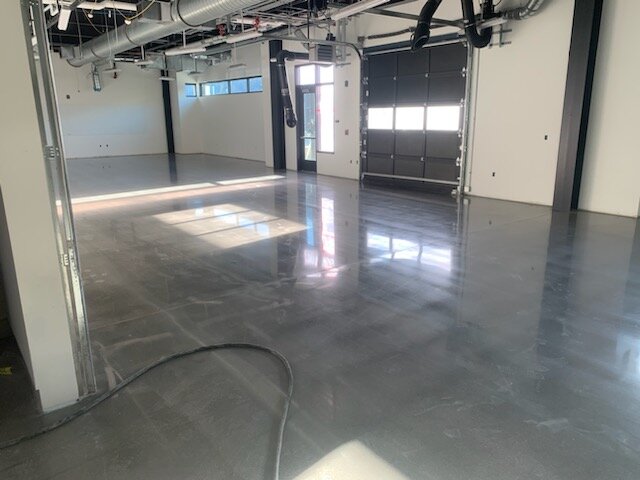
Polished concrete vs epoxy or urethane at a glance
| Polished concrete | Epoxy / urethane coating | |
|---|---|---|
| Forklift and heavy traffic | No coating film to wear through or delaminate; handles continuous forklift, pallet jack and cart traffic. | Systems are specified to your traffic profile; traffic coatings cover loading docks and high-wear zones. |
| Dust | Densifying hardens the surface and stops concrete dusting. | Depends on the system chosen. |
| Chemical exposure | Good when sealed. | Excellent; the choice where oils, solvents or process chemicals are present. |
| Color and color coding | Natural gray tones, some dyes. | Wide range of colors, including color coding. |
| Light reflectivity | A polished surface reflects overhead light and can improve visibility. | Depends on the system and finish. |
| Upkeep | Dust mop plus occasional buffing; no recoating cycle on a sound slab. | Sweep and mop; the coating is a wear layer over the slab. |
| Slab condition | Needs a reasonably sound slab. | Better when the slab is too damaged to polish attractively. |
When polished concrete fits
Polished concrete is refined from the slab you already own: we grind it, densify it and polish it, so there is nothing on top to chip or peel. That is why it is the lowest-cost-of-ownership choice for large open floors such as distribution centers and fulfillment warehouses, and why it handles continuous forklift traffic. Densifying stops dusting, which is better for inventory, equipment and air quality, and the reflective surface can improve visibility and often reduce the number of fixtures needed. See our polished concrete page and the benefits of polished concrete for warehouses.
When epoxy or urethane fits
Choose a coating when the floor has to resist oils, solvents or process chemicals, when you want color coding, or when the slab is too damaged to polish attractively. Traffic coatings suit loading docks and high-wear zones, and cold storage and food processing areas get systems chosen for them. See warehouse and industrial flooring for the systems we install and polished concrete vs epoxy for the broader comparison.
Fix the slab first, whichever you choose
Neither finish rescues a failing slab. Cracks and spalling are repaired before any coating or polish is applied, and control and expansion joints are filled with durable polyurea that protects the edges under forklift traffic. Excess moisture is a leading cause of coating failure, so every slab is tested. If a slab is too far gone for a quality polish, a coating or full restoration is the better route. See concrete slab, crack and spall repair.
Keeping the operation running
Work can be phased by zone and scheduled for nights or weekends, and fast-curing options help keep critical areas operational. That also makes a split approach practical: polish the open floor and coat the zones that need chemical resistance or color coding.
Questions to answer before you choose
- What rolls on it? Forklifts, pallet jacks and carts favor densified polished concrete on a sound slab.
- What spills on it? Oils, solvents or process chemicals point to an epoxy or urethane system.
- Do you need color coding? That is a coating job.
- What shape is the slab in? Cracks, spalls and moisture are handled first, and a badly damaged slab may favor a coating.
- How much downtime can you take? Zone phasing and off-hours work are options.
Weighing a floor for your facility? Request a facility quote and we'll look at your slab and operation, then recommend the right system.
Sources
- BusinessDen: National builder eyes huge industrial redevelopment along South Platte (Matt Geiger, October 15, 2026)
- Denver Business Journal: Decades-old south Denver plant could become 50-acre warehouse campus (Catie Cheshire, October 13, 2026; the full article may require a subscription)
Answers