
Garage Floor Coatings
What Colorado's Road De-Icer Does to Your Garage Floor (and How to Protect It)
Magnesium chloride keeps highways open all winter. Here's what happens when it drips off your car onto the garage slab.
Published
The short answer: magnesium chloride is one of the de-icers the Colorado Department of Transportation uses on state highways, and it rides into your garage on tires and wheel wells (CDOT). The concrete industry treats magnesium-based salts as chemically aggressive to concrete surfaces (NRMCA). A properly installed coating keeps that salt on top of the floor, where it rinses away.
What's on Colorado roads in winter
CDOT's snow removal page says all of its snow removal products contain salt with added corrosion inhibitors. Its solid de-icers include "Ice slicer," made of granular salt and magnesium chloride, and its liquid de-icers include a cold-temperature magnesium chloride used when the pavement is below 16°F. CDOT is responsible for state highways and interstates; cities and counties plow their own local roads.
If you drive a highway on a snowy day, that mix ends up as slush on your car. Back home, it melts off and drips onto the spot where you park.
Why bare garage concrete takes the hit
The National Ready Mixed Concrete Association's guide to scaling (CIP 2) explains that de-icing chemicals increase how saturated the concrete surface gets and how many freeze-thaw cycles it goes through. That leads to scaling: flaking or peeling of the finished surface. The same guide says never to use magnesium-based salts as a de-icer because they are chemically aggressive and destroy concrete surfaces. It also warns that magnesium-based salts used for pre-snow road treatment can be tracked by cars and build up on concrete, and that poor drainage that lets salt solutions sit on the surface makes the exposure more severe.
A garage is a place where meltwater tends to sit. It drips off the car and stays where you park until it's mopped up or dries. Research backs up why that matters. NIST researchers found that magnesium chloride reacts chemically with the ingredients in cement paste. The Federal Highway Administration (FHWA-HIF-17-008) links the growing use of magnesium and calcium chloride brines to a form of concrete deterioration on pavements, and it calls exposure to chemical de-icers the most severe freeze-thaw exposure condition. That research is about roads, not garages, but the chemistry on your slab is the same.
Signs salt is already working on your slab
- Surface flaking or pitting where the car sits or where meltwater runs toward the door.
- Widened cracks and chipped joint edges. Freeze-thaw and de-icers tracked in from winter roads show up this way on Colorado garage floors.
- White residue that comes back after every storm, or bare concrete that looks darker and wetter where you park.
- A coating that's staining, absorbing salt or lifting. That's a coating problem, not a maintenance one.
Pitting, spalls and cracks are repaired during prep, before any coating goes down. See concrete slab, crack and spall repair and signs your concrete floor needs repair.
How a coated floor changes the picture
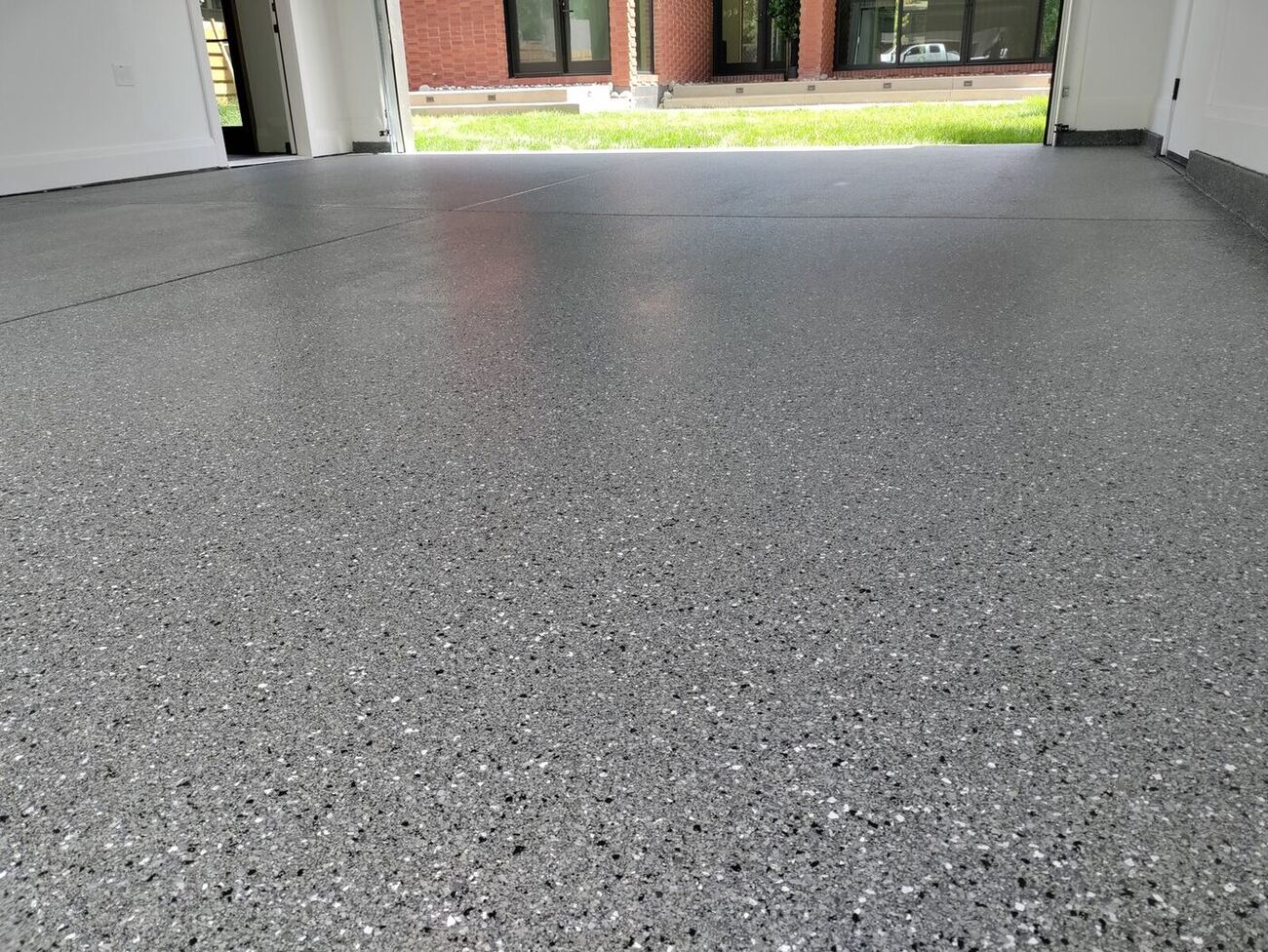
With a professionally installed system, the salt lands on a sealed topcoat instead of soaking into bare concrete. Our flake epoxy floors start with a diamond-ground slab and any needed crack or spall repair, then a pigmented base coat, a broadcast of vinyl flakes and a clear, UV-stable topcoat. For most Colorado garages, that topcoat is polyaspartic, a wear layer built for freeze-thaw movement and de-icers tracked in from winter roads.
| Bare concrete | Coated flake floor | |
|---|---|---|
| Where the salt goes | Onto and into the surface, where NRMCA and FHWA describe scaling and chemical attack | Onto the sealed topcoat, where it mostly sits on the surface |
| Cleanup | Residue works into pores, pits and cracks | Rinse or mop with warm water; a pH-neutral cleaner if needed |
| What hides the mess | Salt lines and wet spots show | Mid-tone charcoal and gray flake blends hide dust, salt and tire marks |
| What to watch for | Flaking, pitting, widened cracks | Staining or lifting, a sign the coating or its prep is the problem |
Prep is what makes this work. Proper mechanical profiling and moisture control keep salt-laden snowmelt from getting under the coating and lifting it. We diamond-grind every slab, with no acid etch shortcuts. More in the best garage floor coating for Colorado winters.
Winter habits that help any garage floor
- Rinse or mop salt and snowmelt regularly through the winter with warm water. NRMCA also advises hosing off salt that cars deposit on garage slabs when conditions permit.
- Squeegee meltwater toward the door instead of letting it sit under the car.
- Use a mat under parked vehicles to catch drips and meltwater.
- Sweep grit before it gets ground in under tires and shoes.
- Choose your own de-icer carefully. For your walks and steps, NRMCA says calcium chloride and sodium chloride (rock salt) are considered acceptable for concrete, used in moderate amounts, and recommends never using magnesium-based or ammonium-based salts as a de-icer.
Our winter garage floor care guide covers the routine for coated floors.
Thinking about coating before next winter?
A slab that has spent weeks under a salty car needs a careful look before it's coated, because anything between the coating and the concrete works against the bond. If you're weighing a cold-weather install, read can you coat a garage floor in a Colorado winter. At a free on-site estimate we'll look at salt damage, cracks and moisture, show you real flake samples and recommend a system. We're insured and serve homeowners across the Denver metro and the Front Range, from Fort Collins to Colorado Springs.
Sources
Answers