Colorado businesses choose polished concrete because it delivers the lowest lifetime flooring cost: it uses the slab you already own, has no coating to peel, withstands forklift and heavy foot traffic, and needs only simple daily cleaning. It also reflects light (cutting lighting costs), resists dust when densified, and looks sharp in retail and hospitality settings. For most warehouses, retail stores, and showrooms, it's the best value floor available.
Walk into a modern Colorado warehouse, big-box retailer, brewery taproom, or auto showroom and you'll likely be standing on polished concrete. It's become the default commercial floor for good reason — the business case is hard to beat.
01Lowest lifecycle cost
Polished concrete refines the slab you already have, so there's no separate flooring material to buy, and there's no coating film that eventually peels and needs replacement. Over a 20-year horizon, that adds up to one of the lowest total costs of ownership of any commercial floor.
02Built for heavy traffic
Densified, polished slabs handle forklifts, pallet jacks, carts, and constant foot traffic without the rutting or delamination that plagues coatings under industrial loads. That makes it a natural fit for warehouses, distribution centers, and manufacturing floors.
03Light reflectivity & energy savings
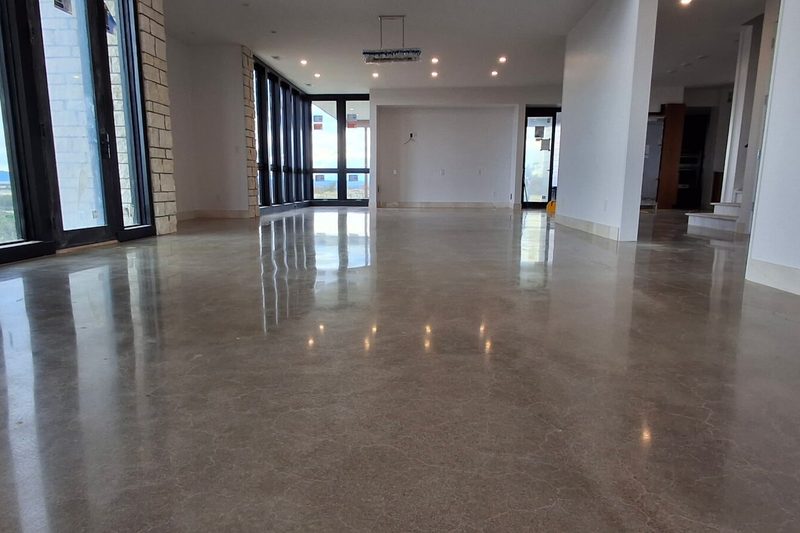
A polished floor reflects overhead light, brightening the space and often letting facilities run fewer fixtures. In big warehouses and retail floors, that reflectivity can meaningfully reduce lighting costs and improve safety.
04Dust-proofing & air quality
Bare concrete constantly sheds fine dust as traffic abrades the surface. The densification step in polishing hardens the surface and stops dusting — a real benefit for clean warehouses, food-adjacent spaces, and any facility that cares about air quality and equipment longevity.
05Low maintenance & easy cleaning
Daily upkeep is usually just dust mopping and occasional damp mopping with a neutral cleaner — no stripping, waxing, or recoating cycles. Less maintenance labor and fewer closures for floor work mean lower operating costs. (See our floor maintenance guide.)
Not sure which floor fits your space?
Our Colorado crews will walk your slab and give you honest options — free.
Book a Free On-Site Estimate06Where each industry benefits
- Retail & showrooms: bright, upscale, seamless floors that reflect product lighting.
- Warehouses & distribution: forklift-tough, dust-free, low-maintenance.
- Restaurants & breweries: polished concrete suits dining rooms and taprooms; back-of-house kitchens usually pair better with a seamless, slip-resistant epoxy or urethane system for food-safety and grip.
- Offices & medical: clean, modern, easy to sanitize.
07Is it right for your facility?
Polished concrete shines when you have a sound slab and want maximum durability with minimal upkeep. If your slab is damaged, or you need specific colors, chemical resistance, or heavy slip resistance, a coating system may be the better call — our polished concrete vs. epoxy comparison breaks down the trade-offs. We also handle commercial repair, resurfacing, and moisture mitigation to get an older slab polish-ready.
Planning a build-out or refresh? Request a free commercial estimate or call (720) 742-6691. We work around your operating hours across Denver and the Front Range.
Key Takeaways
- Polished concrete has one of the lowest lifetime costs of any commercial floor.
- It handles forklifts and heavy foot traffic with no coating to peel or replace.
- Densification stops concrete dusting and reflected light can cut lighting costs.
- Retail, warehouse, and dining spaces suit polish; commercial kitchens suit slip-resistant coatings.