
Garage Floor Prep
Why Do Installers Make Garage Floor Cracks Bigger Before Coating?
Crack chasing looks backwards, but it is how a repair actually holds under a flake or epoxy floor. Here is what happens and why it matters in Colorado garages.
Published
The short answer: a crack has to be opened up before it can be repaired properly. Installers grind a narrow, clean groove along the crack (called crack chasing), vacuum out the dust, fill it with a repair material that has body, then grind the repair flush. A coating poured over an unchased crack tends to sink into it or fail along its edges, and the line shows through the finished floor.
Videos of installers cutting a crack wider before a flake coat have been circulating this fall, and the most common reaction is "why would you make it worse?" The answer is the same reason we grind the whole slab: coatings need clean, sound concrete to grip. Below is what crack repair involves on a garage floor, in the order it happens, and what to ask any installer about it.
Why can't a coating just fill the crack?
Liquid coatings are built to form a film on top of the slab, not to fill a gap. Poured over a crack, the base coat runs down into it, leaving a dip in the finished surface. Hairline cracks also tend to have crumbly, dirty edges, and a coating bonded to loose edges has nothing solid underneath it. One manufacturer's garage prep guide puts it plainly: coatings don't fill cracks, so a filler with body is needed if you want the crack to disappear (WiseBond prep instructions).
That is why crack repair is part of prep, not an add-on. On our concrete and crack repair page we describe it the same way: cracks are cleaned out and filled so they don't telegraph through a new floor or let water in.
What is crack chasing?
Crack chasing means running a grinder with a V-shaped diamond blade along the full length of the crack. It removes the weak, dusty edges and leaves a clean groove with sound concrete on both sides. Product instructions describe this step in similar terms. One epoxy crack repair guide calls for a 1/4 to 3/8 inch V-shaped crack chaser to grind the cracks open, then removing all dust and loose material before filling (Versatile 4900 crack repair guide).
The groove gives the repair material room to anchor and something solid to bond to. It looks like you are making the crack bigger, and you are, on purpose.
How is a chased crack filled?
- Clean it out. Dust, debris and anything oily come out of the groove, usually by vacuum. Repair materials won't bond to dust.
- Fill it slightly proud. A two-part repair material is pressed or poured into the groove and left a little above the surface, because it can settle as it cures.
- Grind it flush. Once the repair has cured, it is ground level with the rest of the slab so the base coat goes down over a smooth, even surface.
- Coat the whole floor. The base coat, flake broadcast and topcoat go over the repaired slab as one system. You can see where each stage fits in our install process.
Will the crack show through my new floor?
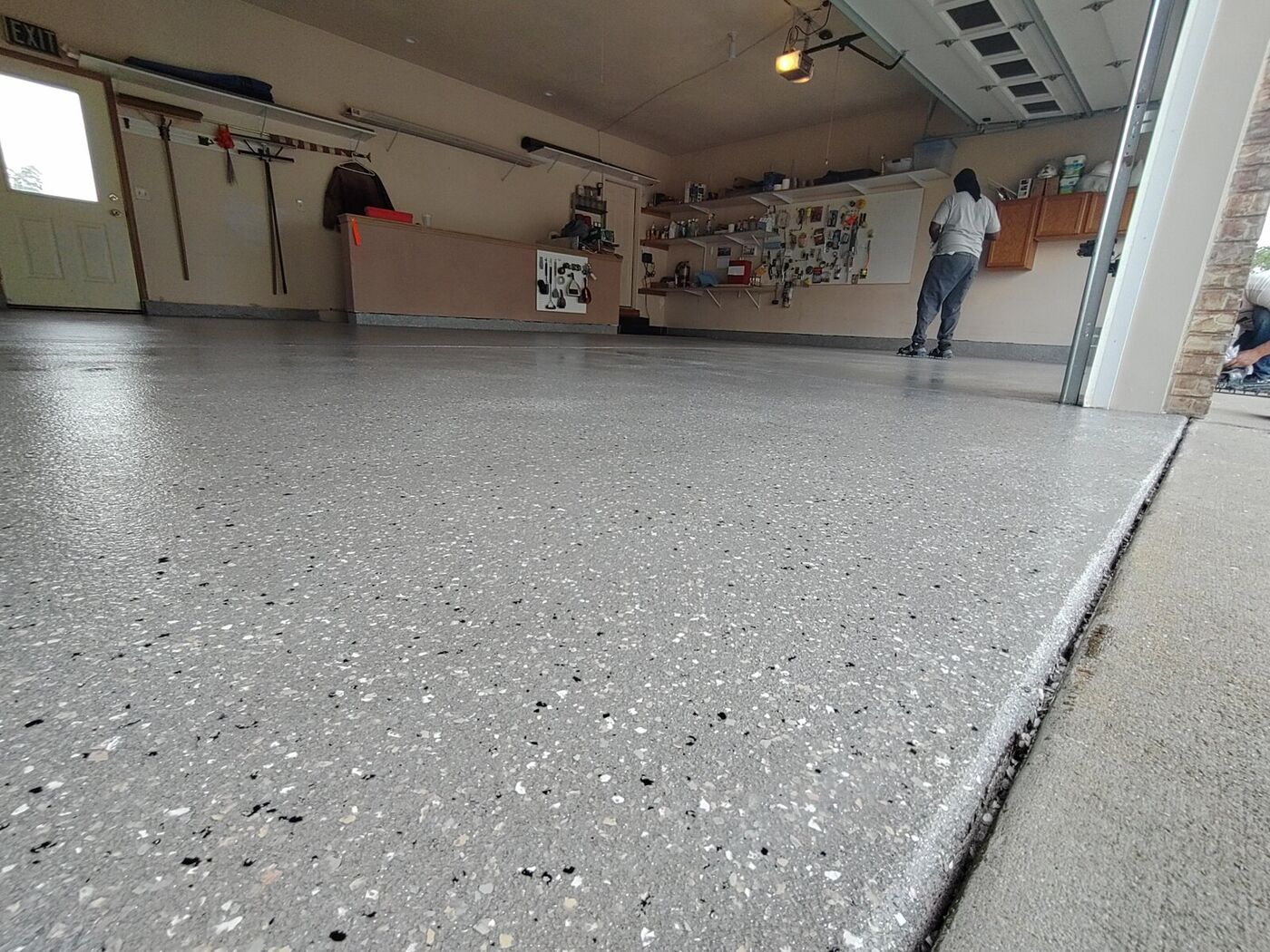
A properly chased and filled crack is usually hard to spot under a full flake broadcast, because the chips break up the surface visually. On a solid-color epoxy, a repair can be more visible, so it is worth asking to see examples. What a coating can't do is stop a slab from moving. If a crack is still active, it can reappear in the coating over time, which is why we look at the cause first, often moisture, freeze-thaw damage or poor original prep.
Control joints are a different case. Those straight saw cuts are there so the slab cracks where it is supposed to. Joints are typically filled and coated over, or kept as a line in the finished floor, depending on the slab. Our repair page notes that control and expansion joints can be filled with durable polyurea to protect the edges.
Why do Colorado garage floors crack in the first place?
Concrete shrinks as it cures, so some cracking is normal on almost any slab. Colorado adds a few things on top of that: freeze-thaw cycles, deicers and magnesium chloride tracked in on tires, and slab moisture. Salty meltwater that sits in a crack can widen it and chip the edges over a few winters. We cover the salt side in our guide to magnesium chloride and your garage floor.
Small shrinkage cracks are routine to repair before coating. Cracks with one side higher than the other, cracks that keep widening, or large areas of spalling and pitting are worth a closer look first. See signs your concrete needs repair for what to watch for.
What should I ask an installer about cracks?
- How will you repair the cracks, and is crack chasing included in the written scope?
- What material goes in the cracks, and is it ground flush before coating?
- How do you handle the control joints?
- Do you check slab moisture before coating?
- Is the slab diamond-ground, or acid etched?
If a quote just says "fill cracks," ask what that means. Two quotes can describe very different amounts of prep. Our garage floor prep guide walks through the rest of the steps.
How Visionary Floors handles cracks
We diamond-grind every slab, with no acid etch shortcuts, and repair cracks, spalls and pitting as part of prep. At the free on-site estimate we look at the cracks with you, explain what each one needs, and put the repair work in the written quote. Visionary Floors is fully insured, has 10+ years of experience, and installs flake garage floors across the Denver metro.
Answers