
Commercial Floors
Is Polished Concrete Slippery? What Denver & Aurora Businesses Should Know
What slip ratings really measure, how shine and upkeep change traction, and how to plan entries and wet zones before you specify polish.
Published
The short answer: clean, dry polished concrete usually isn't slippery, even at a high shine. Wet, oily or dusty floors are a different story, as with any hard floor. Traction comes down to the finish, the cleaning products and how quickly spills are handled, so commercial spaces should plan for wet areas and entries before choosing a sheen.
If you're weighing polished concrete in Denver or Aurora for a store, office, showroom or lobby, slip risk is usually the first question an owner, property manager or architect asks. This guide explains what slip ratings measure, where the industry data agrees and disagrees, and how to set up a polished floor so it stays safe through a Colorado winter.
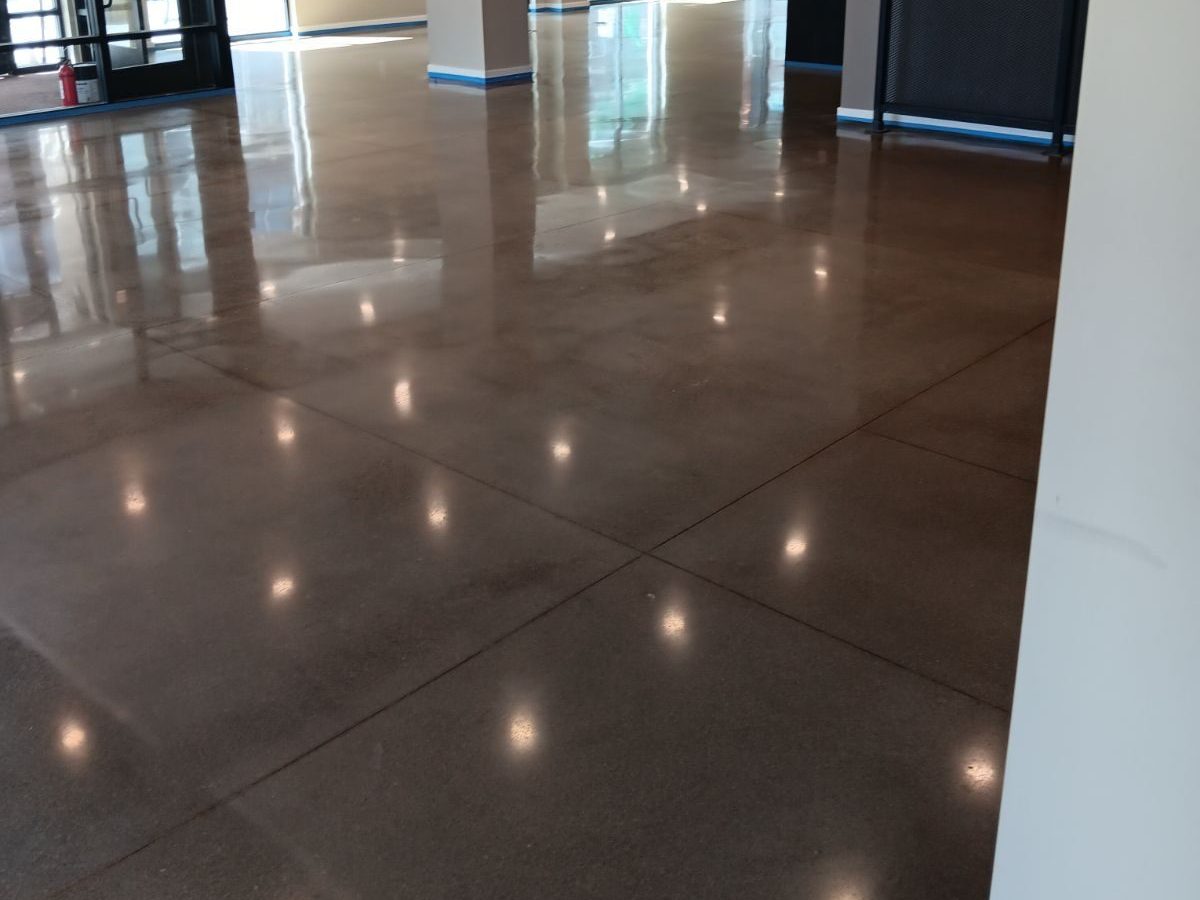
Is polished concrete slippery when it's dry?
Usually not. The shine on polished concrete isn't a wet-look coating sitting on top of the slab. We grind the concrete with progressively finer diamond abrasives, densify it with a silicate hardener and polish it to the sheen you choose, from a soft satin to a mirror-like gloss. What you're seeing is refined, reflective concrete, which can look slicker than it feels underfoot.
That's why the Concrete Polishing Council lists schools, airports, retail spaces, restaurants, hospitals and libraries among typical uses for polished concrete. The catch is the word "clean." Safety Direct America, a slip-testing firm that is critical of polished concrete, reports that some of the polished floors it tested were slip-resistant to most footwear when dry. It also warns that dust and tracked-in parking-lot grease can make even a "dry" area risky on floors with low wet traction (Safety Direct America).
Is polished concrete slippery when it's wet?
It can be. Any smooth, hard floor loses traction when water, oil or grease sits on it, and polished concrete is no exception. How much traction it keeps is where the experts disagree (more on that below). For a business, the practical answer is the same either way: treat the areas that get wet as their own zone, and plan for them.
For workplaces, OSHA's walking-working surfaces rule expects floors to be kept clean and, as far as feasible, dry, and free of hazards such as spills, snow and ice (OSHA 1910.22). The floor finish matters, but so do the mats, the cleaning routine and how fast someone grabs a mop.
What does a "0.42 DCOF" slip rating actually mean?
DCOF stands for dynamic coefficient of friction: how much force it takes to keep something sliding across a surface, compared with its weight. In the U.S., hard-surface flooring is tested under ANSI A326.3 with a device called the BOT 3000E, using a specified rubber test foot and a wetting solution (Craftsman Concrete Floors). The 2021 version sorts flooring into five use categories (TCNA):
| A326.3 category | What it requires |
|---|---|
| Interior, Dry | Dry DCOF of 0.42 or higher |
| Interior, Wet | Wet DCOF of 0.42 or higher, or manufacturer-declared |
| Interior, Wet Plus | Manufacturer-declared |
| Exterior, Wet | Manufacturer-declared |
| Oils/Greases | Manufacturer-declared |
Three things about that number are worth knowing before anyone quotes it to you:
- It isn't a slip prediction. The Tile Council of North America sums up the standard this way: DCOF "can be helpful in comparing surfaces, but it does not predict the likelihood a person will or will not slip."
- It only covers some conditions. The 0.42 threshold is for level interior floors expected to be walked on when wet with water. A326.3 doesn't set measured limits for ramps, exterior areas, or floors contaminated with something other than water, such as oil or grease.
- Topical products change the picture. The standard says flooring with a coating applied after installation should only be used in areas that can be kept dry, unless the coating's manufacturer declares otherwise. If a guard or sealer goes on top of your polished floor, ask what its manufacturer says about wet areas.
Does a higher shine make polished concrete more slippery?
The best-known data point comes from a 2015 lab test. The Concrete Polishing Council (then the Concrete Polishing Association of America) hired the Tile Council of North America to test a 20 x 45 ft slab placed in TCNA's lab. It was ground and polished into 48 test sections covering four aggregate exposure classes and four gloss levels, and 576 wet tests were run with a BOT 3000E under the tile standard of the time, ANSI A137.1. The CPC reports that results varied with gloss level, not aggregate exposure, and that "all test results significantly exceeded the required DCOF of 0.42, even at very high gloss levels" (CPC Position Statement #2).
Two cautions keep that result in perspective. First, it was a fresh, clean lab slab, not a store entry in February. Second, independent field testing doesn't fully agree. Safety Direct America tested polished floors with both the BOT 3000E and a pendulum tester. It measured wet DCOF readings of 0.41 to 0.75, yet it reports wet pendulum results pointing to "high slip risk." Its conclusion is that wet DCOF isn't a reliable way to judge polished concrete.
Our take: gloss is one lever, but it isn't the main one. Water, oil, grit and cleaning residue change traction far more than the difference between a satin and a high-gloss finish. Plan for those first, then pick the sheen.
Which commercial spaces suit polished concrete, and which need a coating?
Polished concrete is a strong fit for dry, high-foot-traffic interiors: retail sales floors, office lobbies and open workspaces, showrooms, corridors, clinic waiting areas and warehouses. See retail and office floors for how we approach those spaces, and warehouse epoxy vs polished concrete for industrial floors.
Areas that stay wet or greasy are a different job. Kitchen lines, dish areas, wash bays and ramps usually call for a textured resin system, where grit is built into the topcoat. Our guides to slip-resistant floor coatings for businesses and restaurant and commercial kitchen flooring cover those systems. Plenty of spaces use both: polish on the sales floor or dining room, and a textured coating in the back of house.
How do Colorado winters change things at the front door?
The first few feet inside the door take the worst of it. Customers track in snowmelt, grit and road de-icer slush from November through spring, and that wet, gritty film is what makes an entry slick, whatever floor is under it. Magnesium chloride brine is also hard on bare concrete. See what mag chloride does to concrete floors.
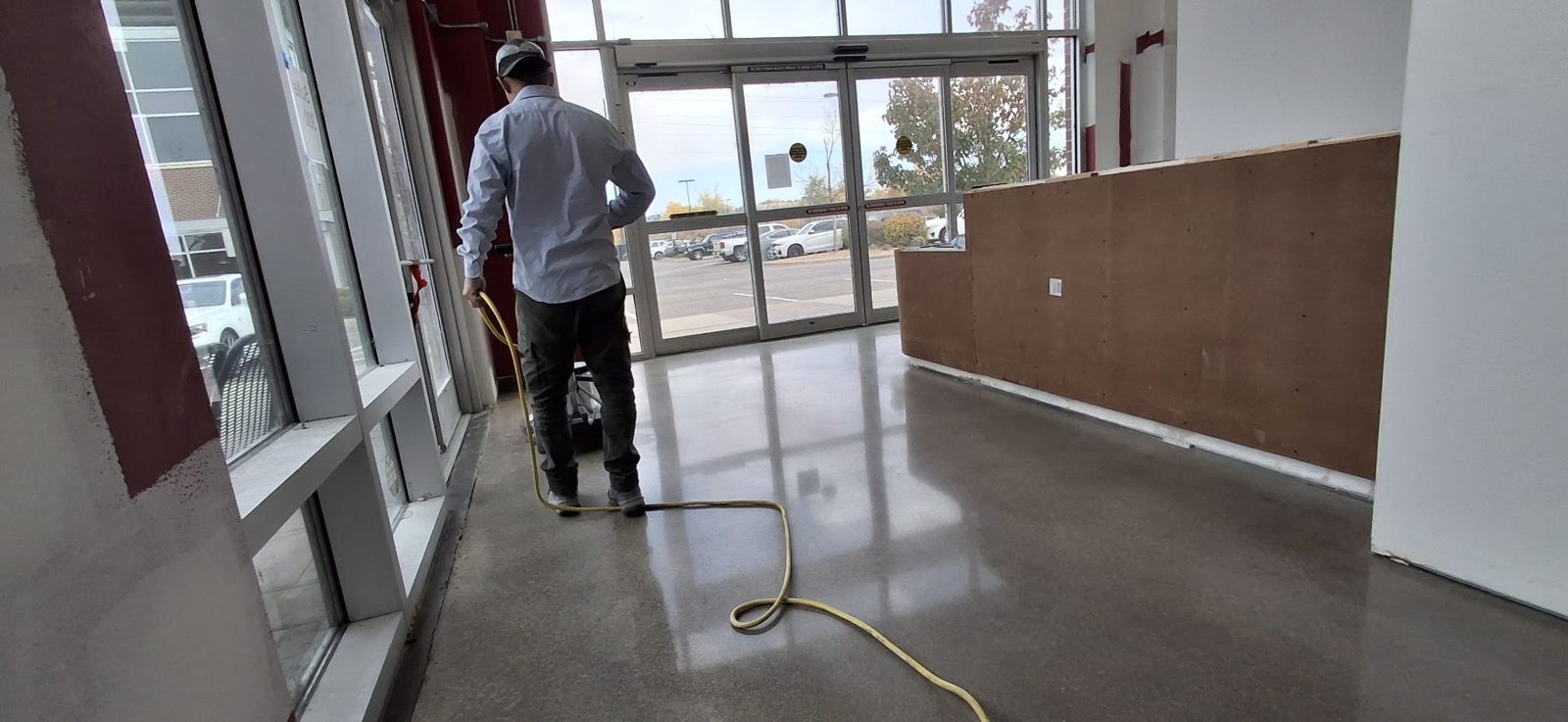
- Put walk-off mats inside and outside the main entries, long enough to take several steps on.
- Check and clean entries more often on storm days, and keep a mop and wet-floor sign near the door.
- Dust-mop daily so grit doesn't sit on the surface and get ground in.
- If a vestibule stays wet all winter, ask whether a textured coating fits that zone better.
How do you keep polished concrete from getting slippery?
Most of it is routine cleaning. Dust-mop grit daily, damp-mop with a pH-neutral cleaner, wipe up spills quickly, and skip waxes, oil soaps and products that leave a film behind. Residue from the wrong cleaner can change how the floor grips. Our guide on how to maintain polished concrete has the full daily, monthly and yearly routine.
Can polished concrete be made more slip-resistant?
Yes, in a few ways. A lower sheen can be chosen for areas that see more moisture. Polished concrete can also take an anti-slip treatment, and true wet zones can get a textured coating instead of polish. The right mix depends on how the space is used, how it's cleaned and where water comes from. We'll make a recommendation at the estimate.
If your architect, insurer or lease requires a slip number, have the finished floor tested by a qualified tester using the method the spec names, and keep the report with your building records.
What are the downsides of polished concrete floors?
It's not the right floor everywhere. Polished concrete needs a reasonably sound slab, and existing cracks, patches and old adhesive will show in the finish. It offers natural gray tones and some dyes rather than a full color range. Where heavy oils, solvents or process chemicals are present, a resin coating is the stronger choice. And like any hard floor, it needs a plan for water at entries and wet areas.
Planning polished concrete in Denver or Aurora?
Visionary Floors polishes concrete for retail, office, showroom and warehouse spaces across Denver and Aurora (see floors in Aurora). We're fully insured, bring 10+ years of floor experience and work from our shop at 6121 Washington St, Unit J, Denver. Book a free on-site estimate and we'll look at your slab, your entries and your wet zones, then recommend a finish for each area.
Sources
- Concrete Polishing Council (ASCC): Position Statement #2, Slip Resistance of Polished Concrete (2015 TCNA lab test; as published in Concrete International, 10/2017)
- Tile Council of North America: Dynamic Coefficient of Friction FAQ (ANSI A326.3)
- Craftsman Concrete Floors: What does 0.42 DCOF mean for a concrete floor?
- Safety Direct America: Many Polished Concrete Floors are Slippery when Wet
- OSHA 29 CFR 1910.22: Walking-Working Surfaces, General Requirements
Answers