
Garage Floors
Garage Floor Paint vs. Sealer vs. Flake Coating: What's the Difference?
Three products that all get called a "garage floor coating," and what the product sheets actually say about each one.
Published
The short answer: a sealer protects bare concrete and, depending on the type, can leave it looking like plain concrete. A floor paint adds a thin layer of color. A flake coating system builds several layers (a base coat, a broadcast of vinyl flakes and a clear topcoat) into a thicker, textured floor. They aren't interchangeable, and the product's label or data sheet tells you which one you're looking at.
All three get called a "garage floor coating" in store aisles and estimates, so it helps to know what each one is before you compare prices or pick a color.
| Penetrating sealer | Garage floor paint | Flake coating system | |
|---|---|---|---|
| What it is | Soaks into the concrete | A single film of color | Several layers: base coat, vinyl flakes, clear topcoat |
| Look | Still looks like concrete | Solid color, satin or gloss | Multi-color flake texture under a clear finish |
| Example source | Family Handyman (silane/siloxane) | Rust-Oleum Concrete & Garage Floor Paint + Primer | Everflow vinyl flake system data sheet |
Sealers: protecting the concrete you already have
Family Handyman splits garage sealers into two groups. Penetrating silane/siloxane sealers soak into the concrete and react with it to form a water-repelling surface that resists water, road salt and other deicers. They won't darken the concrete or make it shiny, so the floor still looks like plain concrete.
Film-forming sealers (acrylic, epoxy and polyurethane, including polyaspartic) seal the pores and give the floor a sheen or "wet look." Family Handyman notes they're easy to clean but need more rigorous surface prep, and they can be slippery, especially when wet.
Floor paint: color in one coat
A garage floor paint is a single film of color. Rust-Oleum's Concrete & Garage Floor Paint + Primer data sheet describes an "advanced acrylic formula" that's self-priming and goes on in one coat. It says the product resists hot tires, oil, grease and gasoline, and also that "occasional touch-up may be necessary for areas subject to heavy vehicle traffic."
Not every floor paint is meant for a garage, either. Rust-Oleum's own Porch & Floor Coating data sheet says that product "is not recommended for use on garage floors." Read the label before you buy.
Two-part epoxy kits
Store-bought epoxy kits are a step up from paint, and they're a different kind of product. The Rust-Oleum EPOXYSHIELD instructions describe a two-part coating (a base and an activator that are mixed before use), a citric-acid etch for prep, and decorative chips tossed onto the wet film. Our posts on DIY vs professional epoxy and grinding vs acid etching explain where kits tend to fall short.
Flake coating systems: built in layers
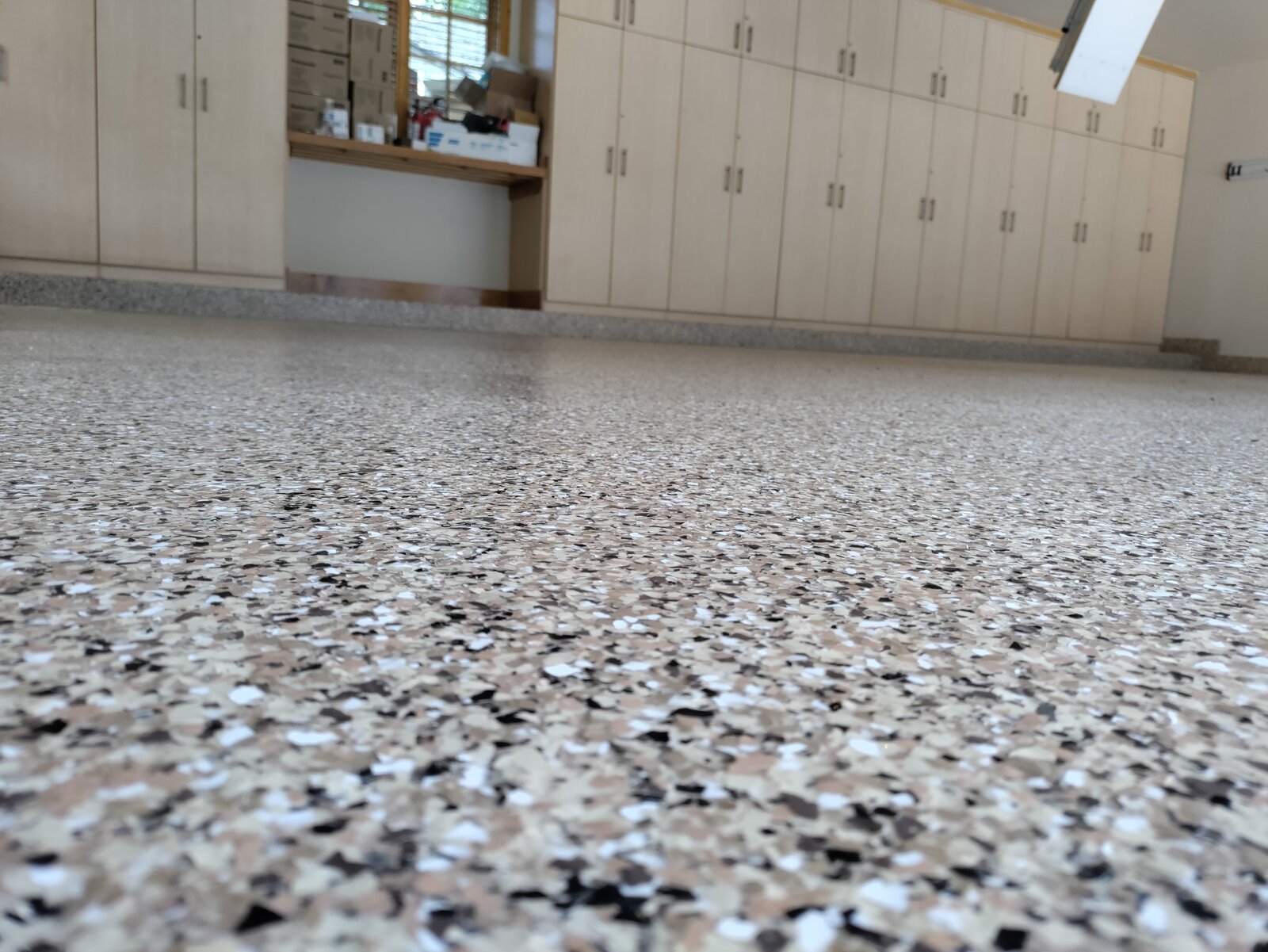
A professional flake floor is a system of layers, not a single product. A typical manufacturer data sheet, such as this one for the Everflow Vinyl Flake Broadcast System, lists:
- An optional primer on the concrete.
- A pigmented base coat, with epoxy or polyaspartic options.
- Vinyl flakes broadcast into the wet base coat. In a full broadcast, the whole floor is covered with flakes.
- A clear topcoat, which can be adjusted for texture, traction and gloss, with UV-resistant options for areas exposed to sunlight.
That layering is what gives a flake floor its texture and color depth. For the choices inside the system, see epoxy vs polyaspartic, polyaspartic vs urethane topcoats, flake design ideas (full vs partial broadcast) and the best flake colors for 2026.
Which one fits your garage?
- You like the look of bare concrete and mainly want protection from water and salt: a penetrating sealer is built for that (Family Handyman).
- You want a quick color refresh: choose a paint whose label says it's made for garage floors, and expect some touch-ups where tires sit (Rust-Oleum).
- You want color, texture and a thicker wear layer: that's what a flake coating system is designed for. See our flake epoxy floors page and flake and polyaspartic garage floors.
Whatever goes down, it's only as good as the slab underneath. Our guides to preparing a garage floor and hot tires and garage epoxy cover the most common reasons a coating fails.
Weighing a flake floor for your garage? Request a free estimate and we'll take a look at your slab.
Sources
Answers