
Garage Floor Coatings
Coating a New-Build Garage Floor in Aurora: When the Slab Is Ready
A brand-new slab can look perfect and still not be ready for a coating. Here's what decides the timing, and which system fits.
Published
The short answer: new concrete has to cure and release moisture before a coating goes down. Coating manufacturers commonly call for at least 28 days of cure as a starting point, but age alone doesn't prove a slab is ready (Sherwin-Williams). We moisture-test new-build slabs during the free estimate and tell you whether yours is ready. For most Aurora garages, the system we recommend is a flake epoxy base sealed with a polyaspartic topcoat.
Why a new slab isn't automatically ready
Freshly poured concrete holds a lot of water. Sherwin-Williams calls it "green concrete" and notes that the standard 28-day cure is only a guideline: the real wait depends on the mix, humidity, temperature and other conditions. If a coating goes on before enough moisture has left the slab, it can trap that moisture and lead to bubbles or peeling. Stonhard adds that in some conditions it can take as long as 60 days before new concrete is ready to coat.
New concrete can also look dry well before it's ready, which is why testing beats guessing. Euclid Chemical's application guide tells installers to test with ASTM F2170 (relative-humidity probes) or ASTM F1869 (calcium chloride) before coating, and to use a moisture mitigation system when readings are high.
What we check on a new-build garage
- Slab moisture: high readings call for a moisture-mitigating primer or a different system.
- Builder cure-and-seal: builders frequently apply a cure-and-seal product. Coatings can't bite into it, so a diamond grind opens the surface.
- Surface laitance and profile: the weak top layer has to come off. Euclid's guide calls for removing laitance and roughening the surface, preferably by mechanical means. We diamond-grind every slab, with no acid etch shortcuts.
- Joints and early cracks: new slabs can still show hairline cracks. Cracks, spalls and pitting are repaired during prep rather than coated over. See concrete repair.
- Sun and use: a west-facing door or a workshop corner changes which topcoat and texture make sense.
Step-by-step details are in how to prepare a garage floor for epoxy and concrete grinding vs acid etching.
Flake base, polyaspartic topcoat: how the two fit together
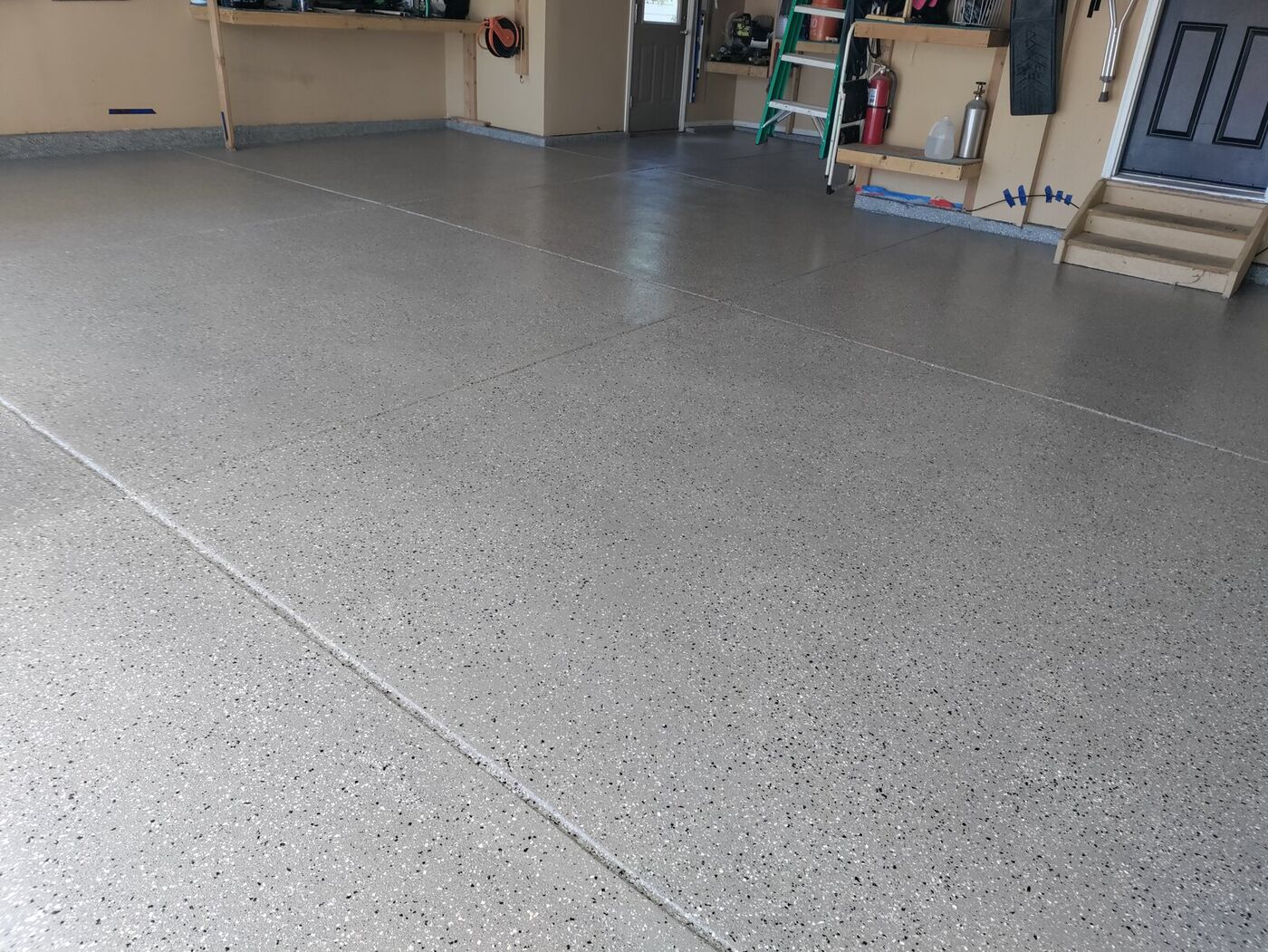
"Flake or polyaspartic?" is a common question, but for most garages it isn't either-or. A flake floor is a coating system: diamond-ground prep, a pigmented base coat, vinyl flakes broadcast into the wet base, and a clear topcoat. Polyaspartic is the topcoat we usually use to seal it.
| Flake epoxy base | Polyaspartic topcoat | |
|---|---|---|
| Role | Bonds to the slab, sets the color and carries the flake | The clear wear layer that takes traffic, hot tires and sun |
| What you notice | Speckled, stone-like look that hides dust, salt and tire marks | Holds its color in sunlight near the garage door |
| Texture | Chips add subtle grip; full broadcast adds the most | Seals the chips; texture can be adjusted |
| Learn more | Flake epoxy systems | Polyaspartic garage floors |
Comparing the chemistry? Read epoxy vs polyaspartic in Colorado and polyaspartic cure time.
Timing your project after move-in
Because readiness depends on the slab, we don't set a date until the moisture readings support it. Once the slab is ready, timing depends on the slab and the system, and we confirm it at your estimate. If you're moving in over the colder months, see can you coat a garage floor in a Colorado winter.
A practical tip: until the floor is coated, try to keep oil, paint and fertilizer spills off the new slab. Stains on bare concrete may need to be ground out during prep.
Questions to ask at your estimate
- How will you test my new slab's moisture, and what do the readings mean?
- Did the builder use a cure-and-seal, and how will you remove it?
- If moisture is high, would you wait or use a mitigation primer?
- What goes into each layer, and can I see real flake samples? (We bring them to the estimate.)
- What does the warranty cover? See what a garage floor coating warranty should cover.
Every Visionary Floors install includes a 1-year warranty, and our estimates are free and on site. We're insured and work throughout Aurora, including Southlands, Saddle Rock, Central Park and Aurora Highlands. See our Aurora service-area page.
Sources
Answers