
For General Contractors
Hiring a Commercial Epoxy Flooring Sub in Denver: A GC's Checklist
What to ask a commercial epoxy or polished concrete subcontractor before you put them on a bid list or a schedule in the Denver metro.
Published
The short answer: ask how the sub will test the slab for moisture and prep the surface, which system and manufacturer they're proposing, what temperature and cure conditions it needs, how they'll phase around other trades, and what insurance and closeout paperwork they provide. Clear, specific answers on prep and moisture matter most.
This checklist is for project managers, superintendents and owner's reps lining up a sub for commercial epoxy flooring in Denver, or for a polished concrete scope. It skips the product overview and sticks to the questions that keep a resinous floor from becoming the punch-list item nobody can fix. Copy the list into your prequal form or your scope review.
Who's doing the work, and are they insured?
Start with who will actually be on your site. A sub with its own crews answers for the prep, the mixing and the topcoat. A sub that passes the work to another installer may not know what that crew did. Ask who self-performs each step, who the foreman will be, and who you call when something comes up mid-install.
Then ask for a certificate of insurance that matches what your subcontract requires, before the sub mobilizes. Licensing is a local question in Colorado. The state Department of Regulatory Agencies notes that general contractors aren't licensed at the state level and points people to their city or county for local rules (Colorado DORA). So check what the jurisdiction on your permit asks of a flooring sub.
How will they test the slab for moisture?
Moisture is the quiet cause behind a lot of failed coatings. ASTM notes that excess moisture in a slab can cause flooring and coating failures such as debonding, and that manufacturers generally require moisture testing before installation. Many specs call for in-situ relative humidity probes under ASTM F2170, and some also call for ASTM F1869 calcium chloride testing.
Two details matter on a GC's schedule. ASTM points out that results show the slab's condition only at the time of the test and in the locations tested, so testing has to happen close enough to install day to mean something. Second, decide what happens if readings come back high before anyone is standing on the slab with material. The options are usually a moisture-mitigation system, a different system, or a schedule change. Some GCs go further and write independent third-party testing into the subcontract, an approach IFTI argues for as a way to manage risk.
How will they prep the surface?
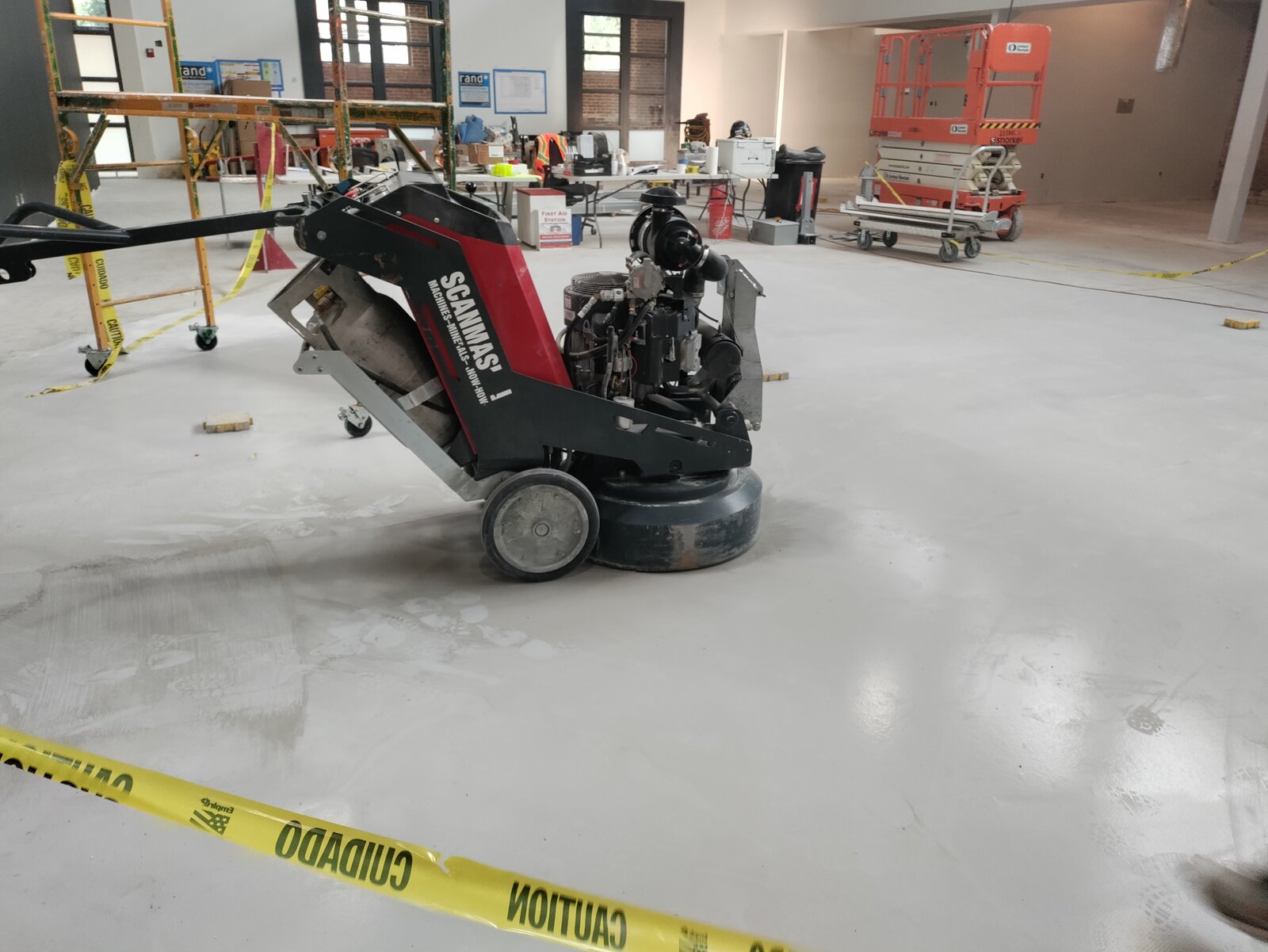
The answer you want is mechanical: diamond grinding or shot blasting to the profile the system's data sheet calls for. That profile is usually described on the concrete surface profile (CSP) scale. ICRI's Guideline 310.2R includes benchmark profiles used to specify and verify prep (ICRI). Acid etching gives an inconsistent profile and can't remove old coatings; see why we grind instead of acid-etch.
Also ask how dust will be controlled. Vacuum-equipped grinders capture most of it, which matters when finished trades or occupied areas are close by.
What system are they proposing, layer by layer?
"Epoxy floor" isn't a spec. Ask your sub to name each layer (primer, body or base coat, any broadcast, topcoat), the manufacturer, and the build. Ask for the product data sheets and safety data sheets for your submittals. The system should match the traffic and chemicals the floor will see: forklifts, oils, solvents, food-prep cleaning or vehicle traffic. Our commercial epoxy flooring page shows how we match systems to industries, and traffic coatings for docks and ramps covers high-wear areas.
How will they handle joints, cracks and old coatings?
This is where change orders come from, so get it into the scope. Ask what the bid assumes for crack repair, spalls and joint filling, and who owns each item: the floor sub, the concrete sub or the GC. Control and expansion joints in forklift areas are often filled with a polyurea joint filler that protects the edges. Cracks and spalls should be repaired before any coating or polish goes down, and a failed coating has to be ground off, not coated over. See crack, spall and joint repair. Structural movement is a separate issue for the engineer of record.
| Item | Typical owner to confirm | Put in writing |
|---|---|---|
| Moisture testing | Floor sub, GC or third-party tester | Test method, locations, timing, plan for high readings |
| Surface prep | Floor sub | Method and target profile per data sheet |
| Crack, spall and joint work | Floor sub or concrete sub | What's included and what's excluded |
| Temporary heat or dehumidification | Often the GC; confirm at award | Conditions the product needs, and for how long |
| Floor protection after install | GC and following trades | Who protects it, with what, until when |
What conditions does the system need?
Resinous systems cure chemically, so slab temperature, air temperature, humidity and dew point all matter. The product data sheet sets the limits. In the Denver metro, the problem is usually winter: an unheated shell, a cold slab at the dock doors, or doors left open for deliveries. Ask your sub what range the product needs, how they'll measure it on the day, and what they need from you, whether that's temporary heat, closed doors or a later slot. Our post on coating a slab in a Colorado winter explains why slab temperature matters more than air temperature.
Where does the floor fit in the schedule?
Most resinous floors go in late: after overhead MEP, ceilings, drywall and paint dust, and before casework, racking, fixtures and equipment. Ask the sub to state, in writing, when the floor can take foot traffic and when it can take full service, for the system and conditions on your job. Those are different milestones. Then agree who protects the floor after install, and how.
On occupied buildings and tenant improvements, ask about phasing. We can work zone by zone and schedule nights or weekends so other areas stay in use. Our clinic flooring guide shows how that looks on a medical build-out.
Epoxy, urethane or polished concrete: which fits the space?
Polished concrete suits large, open, dry floors with foot or forklift traffic on a sound slab, and there's no film to wear through. See commercial polished concrete.
Epoxy suits areas with oils, solvents or process chemicals, areas that need color-coding, and slabs too damaged to polish well.
Urethane cement is the usual pick for commercial kitchens and food-prep areas with hot water and wet cleaning. Many projects mix systems by zone; see warehouse epoxy vs polished concrete and warehouse and industrial floors.
What should be in the closeout package?
- The products used in each layer, with batch numbers if the sub tracks them
- Moisture test results with dates and locations
- The prep method used
- Care and cleaning instructions for the owner, including approved cleaners
- Warranty terms exactly as written in the contract
If you're unsure what the space must meet, our Denver commercial floor code basics covers the common themes. Confirm specifics with the building department.
Working with Visionary Floors
Visionary Floors installs commercial epoxy, urethane, polyaspartic and polished concrete floors from our shop at 6121 Washington St, Unit J, Denver. We're fully insured, with 10+ years of experience and 500+ projects completed, and every project is backed by our 1-year warranty. Every slab is diamond-ground or shot-blasted, moisture is tested before anything goes down, and joints can be filled with polyurea. We can phase work zone by zone or schedule nights and weekends. See how our process works, then request a commercial quote. We'll walk the slab with you and give you a written, zone-by-zone scope.
Sources
- ASTM F2170-19a: Standard Test Method for Determining Relative Humidity in Concrete Floor Slabs Using in situ Probes
- ICRI 310.2R-2013: Selecting and Specifying Concrete Surface Preparation for Sealers, Coatings, Polymer Overlays, and Concrete Repair
- IFTI: Independent Flooring Testing as Risk Transfer (April 25, 2026)
- Colorado Department of Regulatory Agencies: Home & Repair
Answers