
Residential Polished Concrete
Polished Concrete With Radiant Floor Heat: A Guide for Colorado Homes
A heated slab and a polished finish pair well, as long as the heating system and the floor are planned together.
Published
The short answer: yes, polished concrete works well with in-floor radiant heat. Concrete holds and releases heat well, and polishing doesn't add a layer that slows heat transfer. The key is planning: the heating system and the polished floor are built by different trades, so they need to be designed together (Craftsman Concrete Floors). If your slab has radiant heat, tell us at the estimate.
Why the two work well together
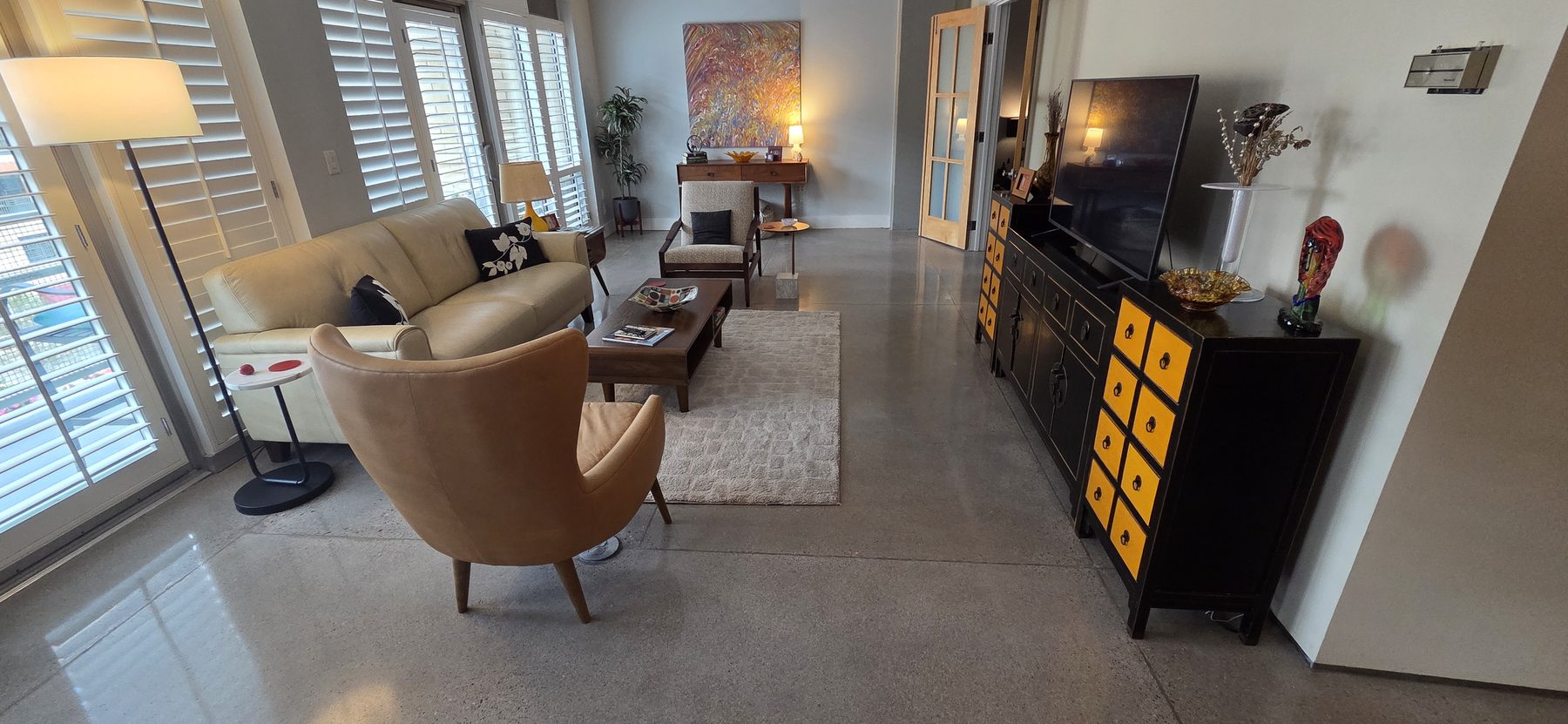
With radiant heat in the slab, the concrete itself warms the room. WarmlyYours lists polished concrete among the floors that work well over heated slabs. Because polishing refines the slab you already have rather than covering it, there's no rug pad, plank or adhesive between the heat and your feet. Our residential polished concrete page covers how we grind, densify and polish.
Comfort is part of why Colorado homeowners ask about it. Concrete holds heat well, so a slab that gets afternoon sun or radiant heating stays comfortable for hours.
New slab vs existing slab
| New slab (new build or addition) | Existing slab | |
|---|---|---|
| Where the heat goes | Hydronic tubing or electric cable is placed in the slab when it's poured (Craftsman) | Heat is already in the slab, or a system is added on top |
| What becomes the floor | The same slab is later polished as the finished surface | If a system is added on top, it's covered by a new layer, so the original surface is no longer the finish (Craftsman) |
| What to plan | Tubing or cable layout, joints and finishing sequence, planned as one assembly | The as-installed layout and depth of the existing system, before any work starts |
On new construction, every layer can still be decided. WarmlyYours describes in-slab cable installs where the heating element ends up 2 to 3 inches beneath the finished concrete surface, and the International Mechanical Code requires the top of hydronic tubing embedded in a structural slab to sit at least 2 inches below the surface (UpCodes, IMC 1217.5). The same code section calls for insulation under and around the edges of a radiant slab poured on soil.
Planning a polished floor over radiant heat
- Keep the layout records. Craftsman points to the as-installed tubing or cable layout with designed depths, and the joint plan, as the documents every later trade relies on. Ask your radiant installer for them.
- No cutting, coring or anchoring blind. Craftsman notes that later trades may cut, core or anchor into the floor, and that an accurate record of layout, depths and joint locations lets that work be kept clear of the embedded system.
- Let the slab cure before heating it. The FloorHeat installation manual says not to run the system to speed up curing unless the engineer directs it, and to raise the supply temperature gradually once the slab is ready.
- Mind floor-surface temperature. FloorHeat notes that many comfort standards cap occupied floor surfaces at around 85°F, a figure WarmlyYours also uses for most floor coverings. Your radiant designer sets the system's limits.
- Cracks and repairs: cracks can be filled so they're less noticeable, and polished concrete keeps some character of the original slab. See concrete repair for interior slab repairs.
One boundary to know: the radiant system belongs to the radiant specialist, who handles its design, controls, testing and performance (Craftsman). Visionary Floors handles the floor: grinding, densifying, polishing and interior slab repair. We'll coordinate with your radiant installer or builder.
Caring for a heated polished floor
Day-to-day care is the same as any polished floor: dust-mop grit and damp-mop with a neutral pH cleaner. Our polished concrete care guide covers the routine, and area rugs pair well with polished concrete in living spaces. Weighing it against other floors? See polished concrete vs LVP.
What to tell us at your estimate
- Whether the slab has radiant heat, and whether it's hydronic or electric.
- Who installed it, and whether you have the as-installed layout or photos taken before the pour.
- Whether the slab is new or existing, and roughly when it was poured.
- What sheen you're after, from satin to high gloss.
Estimates are free and on site, we're insured, and we serve homes across the Front Range from our Denver shop. Request a free polished concrete estimate.
Sources
- Craftsman Concrete Floors: Radiant Heating in Polished Concrete Floors
- WarmlyYours: How to Install Radiant Heating In or On a Concrete Floor
- FloorHeat: In-Slab Hydronic Radiant Heating Installation Manual (Slab-on-Grade)
- UpCodes: International Mechanical Code, Radiant Heating and Cooling (Section 1217)
Answers